
Last updated October 15, 2026
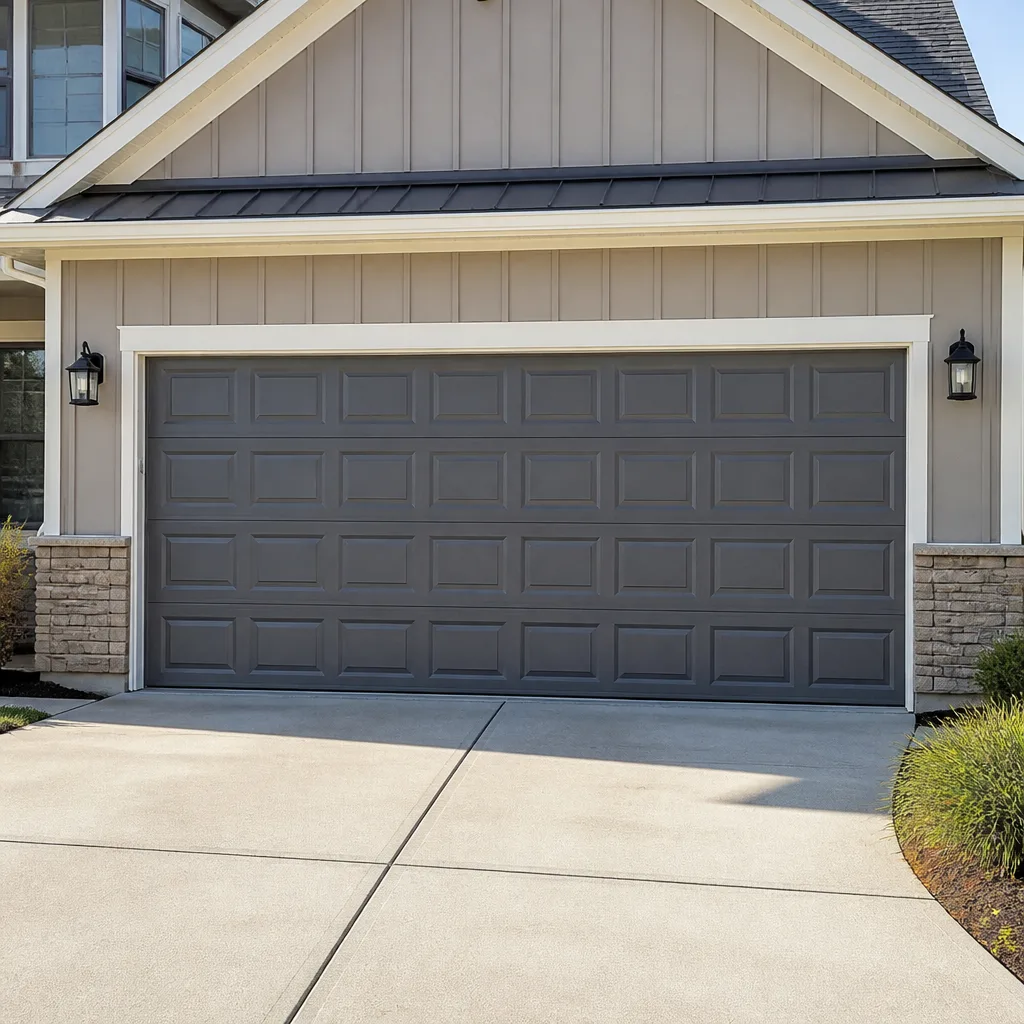 Raised-panel steel
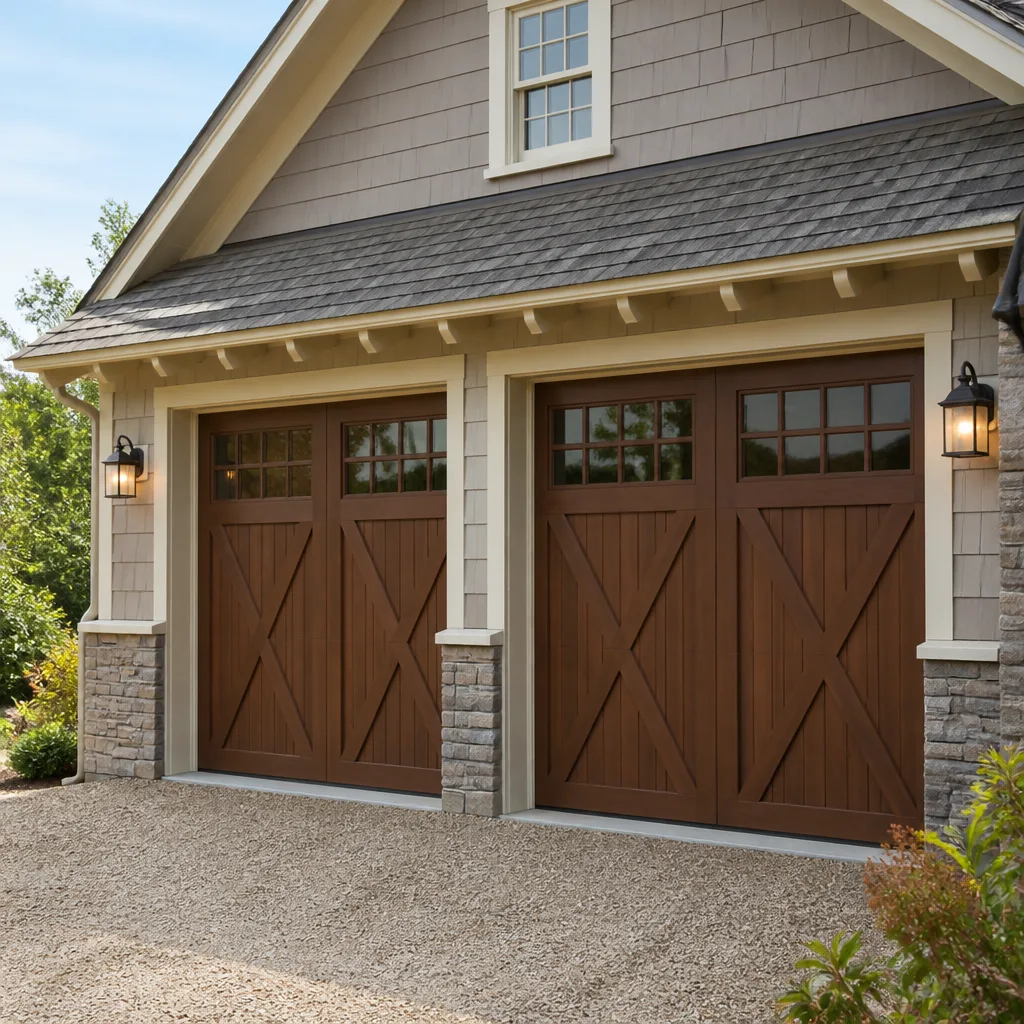 Carriage house
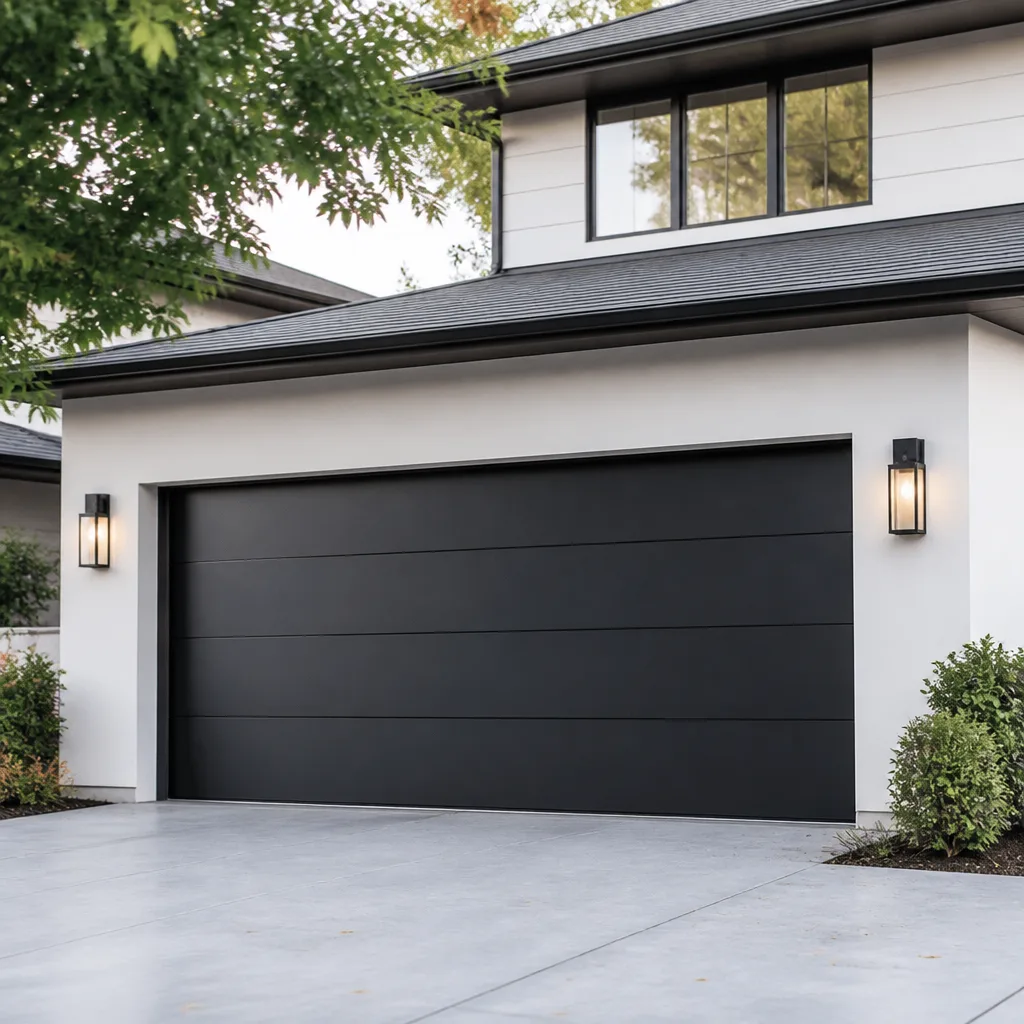 Modern flush
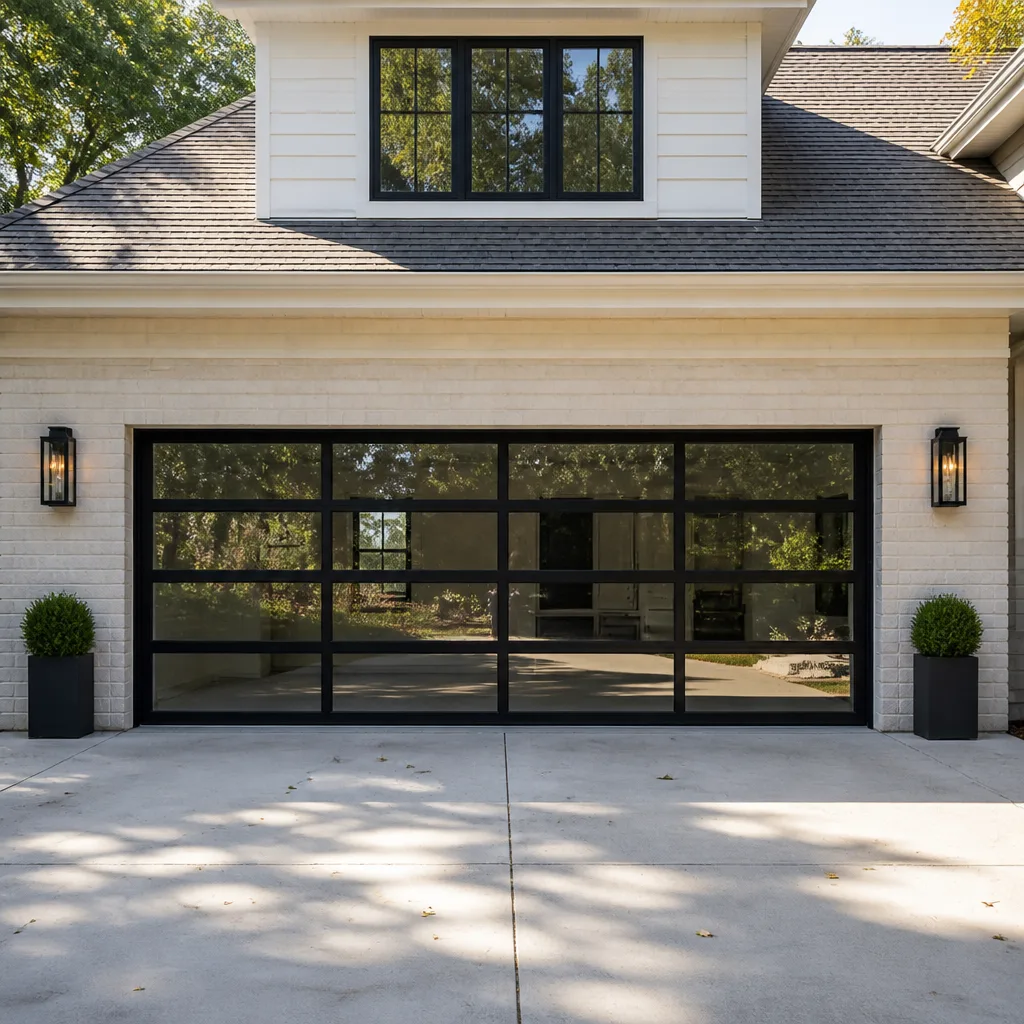 Full-view glass
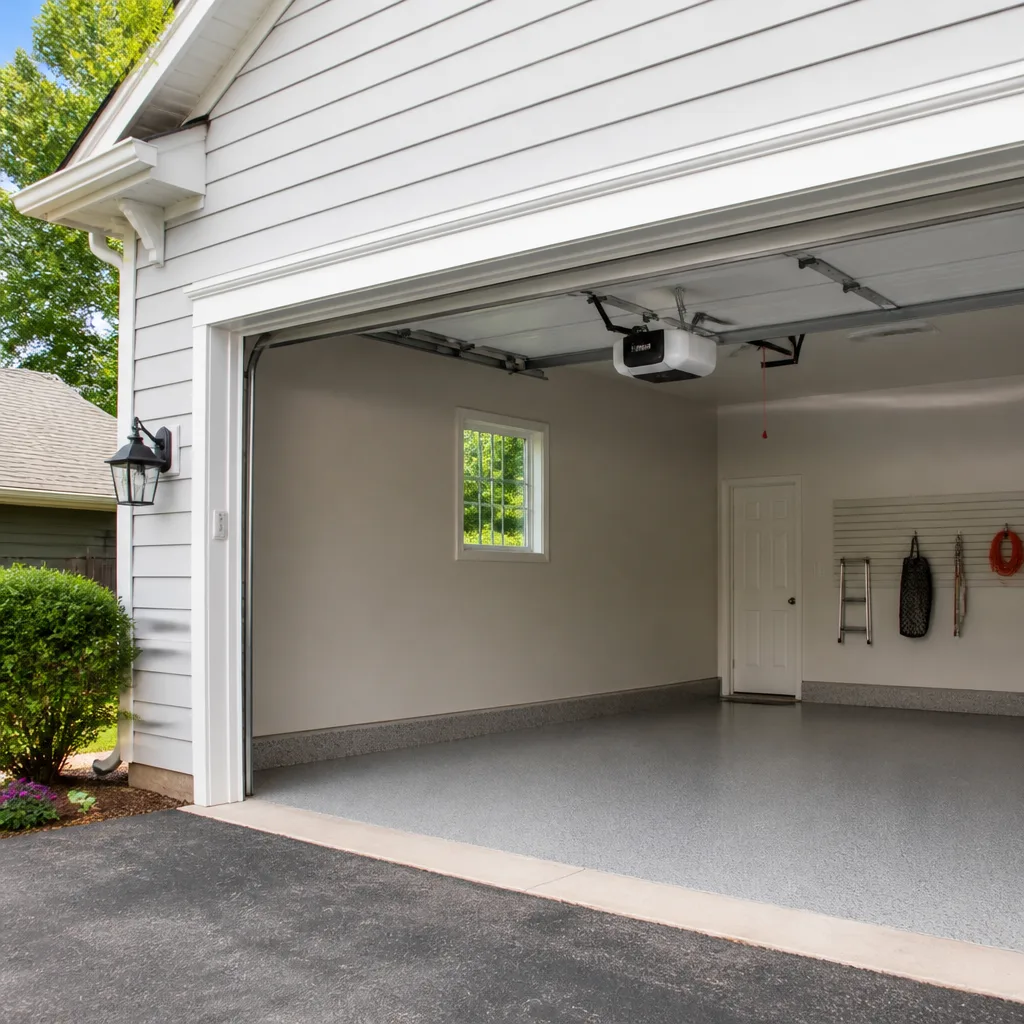 LiftMaster openers
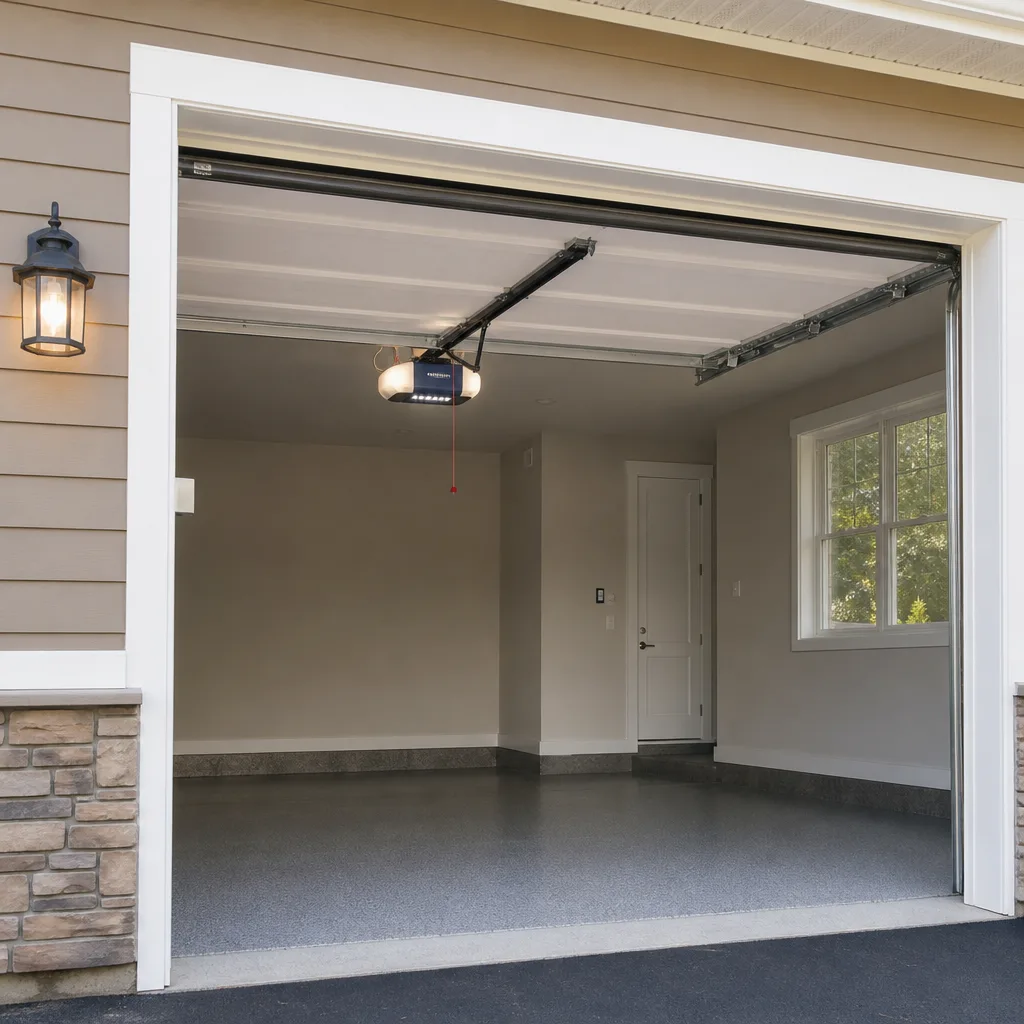 Chamberlain openers
Full 25-point door and opener safety check with every visit - springs, cables, rollers, tracks, and your LiftMaster or Chamberlain opener included
You get a price before we start. It does not change when the truck arrives.
Get your free estimateThe Complete Guide to Garage Door in Los Angeles
Most garage door guides are written for Ohio winters. They dwell on frost heave, ice sealing the bottom panel shut, and whether a 1/2 horsepower opener can muscle through six inches of snow drift. Los Angeles homeowners share almost none of those problems. But we have our own, and almost no one is writing about them: marine-layer corrosion eating steel panels in Santa Monica, heat fatigue snapping torsion springs in Reseda, and seismic code requirements that change what you’re allowed to install and how. This guide maps every decision you’ll face as a Los Angeles homeowner, from material selection to opener logic, against the actual conditions of your ZIP code, and our more guides & resources cover related topics in depth.
Quick Answer
A garage door in Los Angeles needs to do three things most national guides never mention: resist salt-air corrosion if you live within five miles of the coast, survive heat cycles that fatigue springs faster than anywhere else in California, and meet seismic bracing standards for LA County. The most common door types here are sectional steel and aluminum, the most common spring failure is heat-accelerated torsion spring fatigue, and most opener installations in 2026 are DC-motor belt drives with battery backup. Expect to spend $800 to $2,400 for a quality mid-range door installed, $150 to $280 for a torsion spring replacement, and $450 to $900 for a high-quality opener with installation; see our Garage Door Cost Breakdown: The Los Angeles Homeowner’s Reference for 2026 for full pricing context.
Styles & brands we work with
Table of Contents
- The Coastal Corrosion Problem: What Salt Air Does to Your Door
- Why Valley Heat Kills Springs Faster Than Anywhere in California
- Steel, Aluminum, Wood, or Glass: Choosing the Right Material for Your Block
- Garage Door Opener Basics: UL 325, Battery Backup, and the LA Seismic Picture
- Sectional vs. One-Piece Tilt-Up: The Older LA Home Question
- How to Read a Garage Door Quote in Los Angeles: Line Items, Padding, and Fair Ballparks
- Insulation and R-Value in an LA Climate: What Actually Matters
- A Seasonal Maintenance Schedule That Makes Sense for Los Angeles
The Coastal Corrosion Problem: What Salt Air Does to Your Door
We’ve replaced doors in Pacific Palisades that looked fine from thirty feet away but had rust blooming behind the bottom weather seal and along the inside of the tracks. That’s the reality of garage doors within five miles of the Pacific. The marine layer doesn’t just dampen your morning; it carries salt aerosol that settles into every joint, hinge, and bolt on your door. Steel is the default material for most garage doors in the country, and it works fine in Santa Monica if you choose the right grade. The problem is that most homeowners, and plenty of installers, don’t distinguish between galvanized steel and raw steel. Raw steel doors, common in budget installations, will show rust spotting on the lower panel within three to five years in El Segundo or Manhattan Beach. Galvanized or galvalume steel, which carries a zinc or zinc-aluminum coating, resists that corrosion for a decade or more.
The hardware is actually the weak point most people never inspect. Hinges, track brackets, and bottom fixtures are often made from uncoated steel or lightly plated steel. In coastal Los Angeles, those components fail before the panels do. If you live west of the 405 and south of Malibu, you want stainless steel hinges and brackets, not standard plated hardware. The cost difference is modest, typically $40 to $80 on a full installation, but it’s rarely offered. That’s the kind of detail that separates a door that lasts eight years from one that lasts eighteen.
Aluminum doors are the other coastal answer. They don’t rust, period. The trade-off is that aluminum dents more easily than steel. If you have teenage drivers or a basketball hoop within fifteen feet of the door, think about whether that matters to you. For most coastal homeowners in Venice or Marina del Rey, an aluminum door with a factory finish is the single most practical choice. It shrugs off the salt, it’s lighter than steel, and it puts less load on the springs and opener, which means fewer downstream failures. Raynor makes a line of corrosion-resistant coastal doors that we’ve seen hold up well in the Marina. We’d rather see a homeowner pick the right material once than fight rust forever.
Why Valley Heat Kills Springs Faster Than Anywhere in California
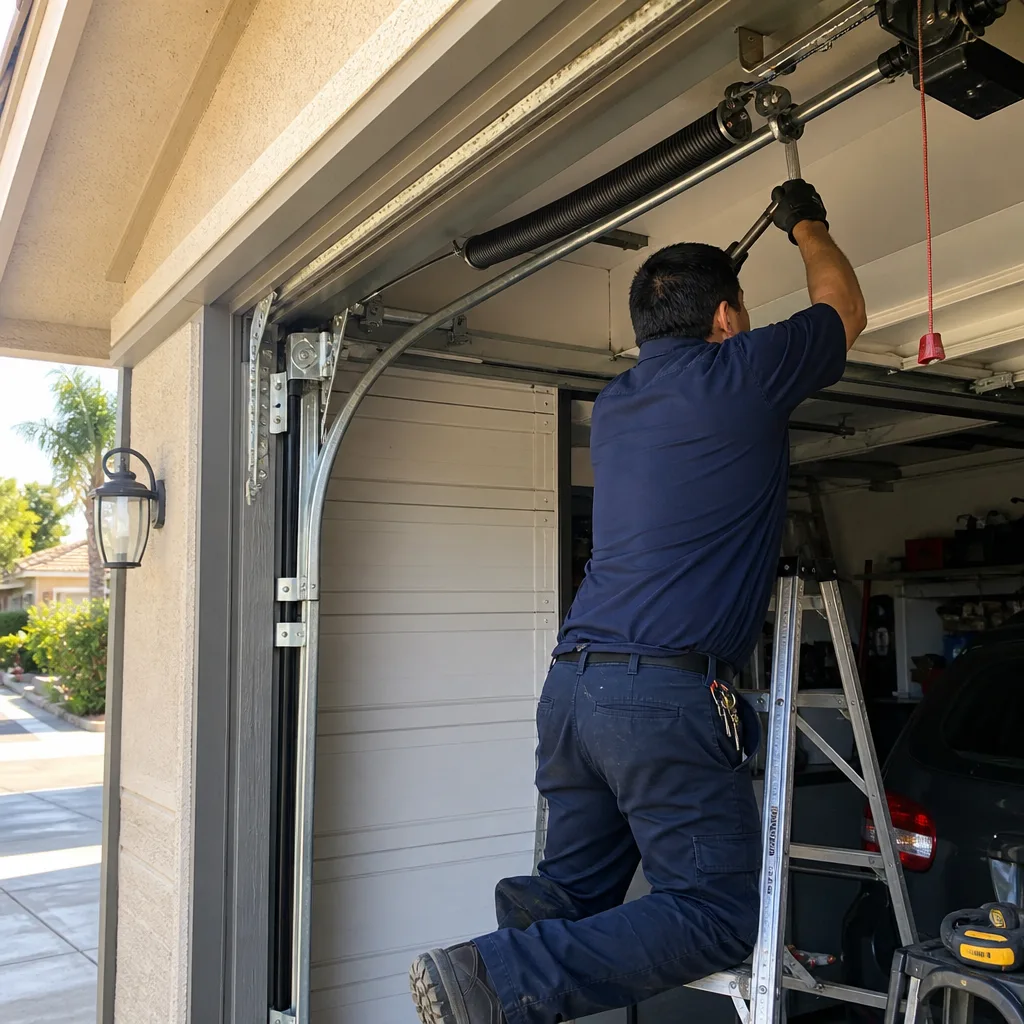
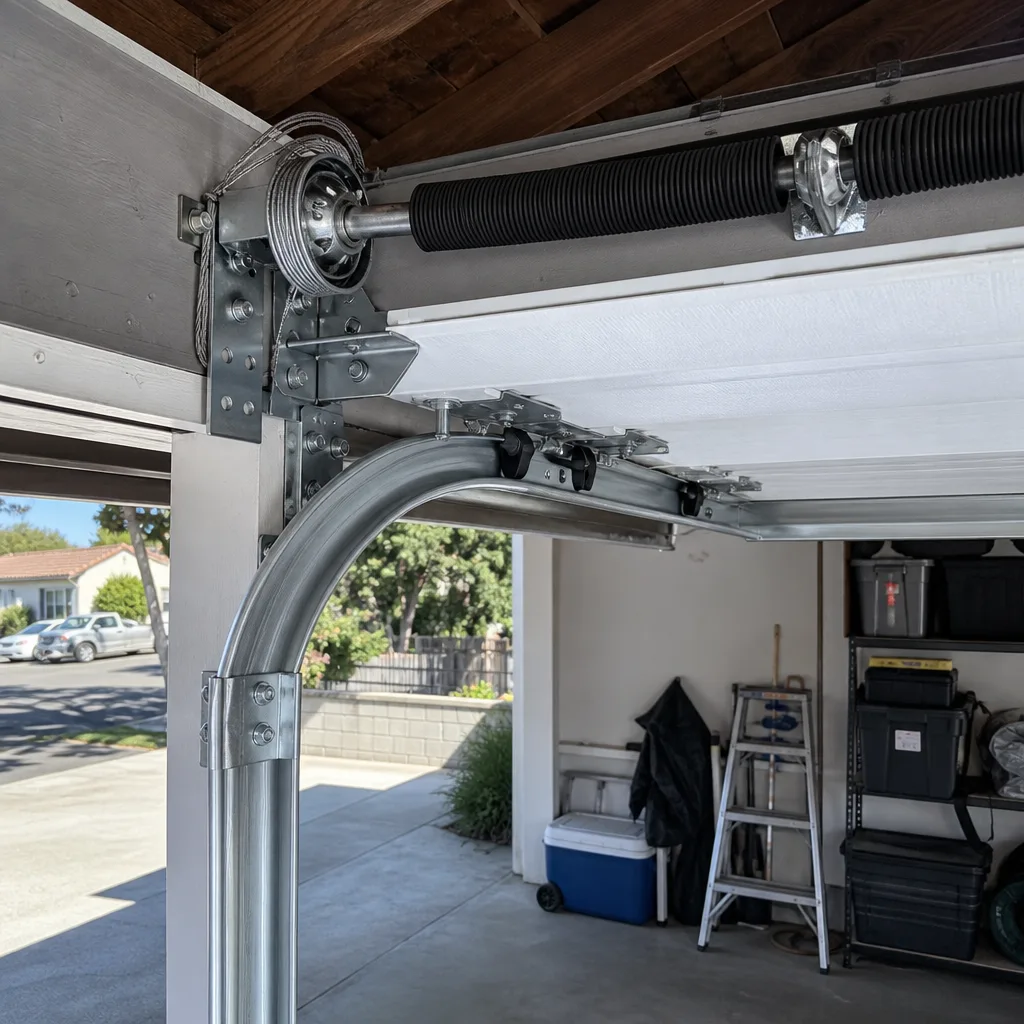
Torsion springs, the heavy coils mounted above the door that handle most of the lifting weight, are rated in cycles. A standard spring is good for 10,000 cycles, which sounds like a lot until you do the math. If you open and close your door four times a day, that’s roughly seven years. Most of that math assumes the spring is operating in moderate temperatures. It doesn’t account for what a Chatsworth summer does to metal. Sustained heat above 95 degrees accelerates the microscopic fatigue that eventually causes a spring to snap. We see it constantly in the Valley: springs failing at the 6- or 7-year mark in Reseda, Canoga Park, and Northridge when the same spring in coastal Long Beach might run ten years without incident.
The practical implication is that Valley homeowners should choose high-cycle springs when they replace them. A 20,000-cycle spring costs about $20 to $40 more than a 10,000-cycle spring, and it buys you roughly twice the lifespan. That’s the best money you’ll ever spend on your garage door. If a technician is quoting you a spring replacement, ask what cycle rating you’re getting and insist on at least 20,000 cycles for a Valley address. Most garage door spring repair in Los Angeles includes the option, but it’s rarely offered unprompted because the lower-cycle spring is cheaper and most homeowners never ask.
Heat also affects opener motors indirectly. An opener that struggles against a heat-weakened spring will overheat its own motor and trip its thermal overload. That’s the classic August service call for the San Fernando Valley: the door won’t open at noon because the spring lost tension and the opener gave up. The fix isn’t a new opener. It’s catching the spring before it fails. A door that starts feeling heavier mid-summer is telling you something. Listen to it.
Steel, Aluminum, Wood, or Glass: Choosing the Right Material for Your Block
Material choice is where Los Angeles geography comes before garage door geography. The right door for a Spanish bungalow in Silver Lake is not the right door for a modern in Playa Vista, and the right door for a Sherman Oaks ranch is not the right door for a Malibu beach house. Here’s what we know from working across all those neighborhoods.
Steel remains the broad default, and for good reason. It’s the best strength-to-price trade in the industry. A quality 24-gauge or 25-gauge steel door with a factory finish and polyurethane insulation will run $900 to $1,800 installed for a standard two-car 16×7, depending on window cutouts and decorative hardware. Steel can live happily in the Valley, on the Eastside, or in the coastal plain east of the 405. The caveat is coastal proximity, as described above, and the fact that steel transfers heat. If your garage faces west in Woodland Hills, a steel door will heat up fast in July. Insulation helps, but it’s not a cure.
Aluminum is lighter, rust-free, and more expensive for a comparable build, typically $1,200 to $2,400 installed. It’s the right call for coastal Los Angeles and for homeowners who prefer a slimmer sightline. Modern aluminum doors with glass infills are popular in the Arts District and Hollywood Hills, but note that glass panels reduce insulation value and privacy. Full vinyl is an option too, mostly at the budget end, and while it resists salt well, it’s not as rigid as steel or aluminum and tends to fade over time in direct sun.
Wood is the premium statement, common in Hancock Park and the prewar neighborhoods of West Adams and Los Feliz. A custom wood door can run $3,000 to $8,000 or more depending on species and design. Wood requires refinishing every few years in Los Angeles sun, and it’s the highest-maintenance material by a wide margin. We don’t discourage it; we just want people to know what they’re signing up for. A wood door in full west-facing sun will demand sanding and sealing far more often than one in a shaded canyon.
Glass and glass-and-aluminum doors are architectural and expensive, $4,000 to $10,000-plus, and they make sense when the garage doubles as a studio, gym, or workspace. If that’s you, budget for proper sealing and understand that glass panels are tempered and heavy. Your springs and opener need to be sized accordingly.
Whatever material you choose, know that garage door installation in Los Angeles should include a spring sizing calculation based on the door’s actual weight, not a guess. A door that’s under-sprung will sag, bind, and burn out openers. A door that’s over-sprung will jerk and stress its hardware. Weight drives everything.
Garage Door Opener Basics: UL 325, Battery Backup, and the LA Seismic Picture
California has been ahead of the rest of the country on garage door openers since UL 325 took effect in 1993, requiring auto-reversing safety sensors. Every opener legally installed in Los Angeles will have an infrared beam mounted about six inches off the floor on either side of the door opening, and California added SB 969 in 2019 requiring battery backup on all newly installed residential openers; for full details, see Garage Door Permits, Codes & Inspections in CA: What You Need to Know. That’s the law, and it means a properly installed Los Angeles opener will still work during a power outage. If the opener is old enough to predate battery backup, it’s out of compliance by current code.
For most Los Angeles homeowners, the practical question is belt versus chain versus screw drive. Belt drives are the quiet choice and the right pick for attached garages where a bedroom sits above or adjacent. A quality belt-drive opener from LiftMaster or Chamberlain with battery backup runs $450 to $900 installed. Chain drives are louder but durable and cheaper, $350 to $700 installed. Screw drives sit in between on noise and are less common in new installs. For detached garages, a chain drive can be a perfectly sensible budget decision, and you’ll never hear it from inside the house.
Seismic bracing is the Los Angeles-specific point that generic guides skip. LA County code requires garage door tracks, particularly the vertical and horizontal track systems, to be anchored securely to the structural framing. In an earthquake, an unanchored door can jump its tracks, and a door that drops on a car or a person is a serious hazard. Most post-2000 installations are compliant, but we still see older track systems in Mid-City and Boyle Heights held by drywall anchors or undersized lag bolts. If you have an older door, it’s worth a garage door repair in Los Angeles visit to verify that the tracks are properly braced for seismic loading. The service call is cheap compared to what an earthquake can do to an unbraced door.
Sectional vs. One-Piece Tilt-Up: The Older LA Home Question
Los Angeles has a huge stock of homes built between 1945 and 1970, and a surprising number of them still have one-piece tilt-up garage doors. If you’re not sure what you have, look at how the door opens. A sectional door is made of horizontal panels that roll up a curved track into the garage ceiling. A one-piece door is a single solid panel that tilts out and up on side pivots, sticking out past the front of the garage when open. It’s the classic old-LA look, and you’ll see them all over Westchester, Torrance, and the postwar tracts of Lakewood and Norwalk.
Here’s what you need to know in 2026: replacement parts for one-piece doors are becoming genuinely scarce. Manufacturers have mostly exited the category, and the hardware that fails first, the side hinges, the pivot plates, and the counterweight springs, are increasingly special-order items. When a one-piece door fails, you’re often looking at a lead time of two to three weeks for parts, and that’s if the specific hardware is still produced at all. The better move for most homeowners with a one-piece door is to plan a conversion to a sectional door before the door fails. A sectional replacement gives you better sealing, more insulation options, and a parts universe that will be stocked for decades. The conversion typically costs $1,500 to $3,000 depending on the opening and finish choices, and it usually pays for itself in reduced frustration and future repair accessibility.
The other issue with one-piece doors is safety. Those side springs and pivot arms are under enormous tension, and when a one-piece door comes off its track, it’s heavy enough to cause serious injury. We don’t recommend servicing one-piece door hardware yourself. The springs on these units are unforgiving, and a door that weighs 300 pounds falling out of a raised position is dangerous. Let a pro handle it.
How to Read a Garage Door Quote in Los Angeles: Line Items, Padding, and Fair Ballparks
Homeowners in Los Angeles get burned by garage door quotes more than almost any other home service. The trade’s reputation for bait-and-switch pricing is real, and the most common version goes like this: the phone quote says $79 for a service call, the technician arrives and “discovers” a problem that wasn’t mentioned, and suddenly the final number is $900. We built our entire service model around not doing that. The written price is provided before any work starts, every time, without exception. But you should know how to read a quote even if you’re not calling us.
Here’s what a legitimate quote should contain, line by line:
- Door or opener model and size. If it just says “16×7 door,” ask for the specific model. You have a right to know what you’re buying.
- Material and panel construction. Steel thickness, insulation type, finish. Vague language here is a red flag.
- Spring size and cycle rating. This is the most commonly omitted line item. If it’s missing, ask. In the Valley, insist on 20,000-cycle minimum.
- Track and hardware specification. Standard or heavy-duty, and for coastal installs, stainless or standard plated.
- Installation labor. Usually bundled into the door price but should be listed separately on request.
- Removal and disposal of the old door. If this isn’t on the quote, you may get a surprise charge for haul-away.
- Warranty terms. What’s covered, for how long, and in writing.
The padding items to watch for are “premium grease package,” “track reinforcement,” and “minor hardware replacement” being quoted at $200 or more when the actual cost is a few dollars. A fair ballpark for a standard two-car 16×7 steel door in Los Angeles in 2026 is $800 to $2,400 installed. A torsion spring replacement should run $150 to $280, parts and labor included. An opener is $350 to $900 installed. If a quote lands well outside those ranges, ask exactly what’s driving the difference. And if the price changes once the technician arrives, you’re not obligated to proceed. A written quote that’s honored is the minimum standard for any company you let work on your home.
Insulation and R-Value in an LA Climate: What Actually Matters
Insulation in garage doors is measured in R-value, which tells you how well the door resists heat transfer. An uninsulated single-layer steel door is around R-2. A double-layer door with polystyrene insulation lands around R-6 to R-9. A triple-layer polyurethane door can reach R-12 to R-18. In Minneapolis, the R-value debate is a real debate. In Los Angeles, the picture is different, and simpler than most insulation marketing would have you believe.
If your garage is detached and you don’t spend time in it, insulation is mostly irrelevant. The door keeps rain out either way, and the garage will be hot in summer and cool in winter regardless. Don’t pay a premium for R-18 in a detached garage in Granada Hills unless you’re converting the space. If your garage is attached, insulation does two useful things: it moderates the temperature in the garage itself, which matters if you store heat-sensitive items or use the space as a workshop, and it reduces heat infiltration into the adjoining rooms of the house. For an attached garage in the west San Fernando Valley, where August afternoons run 100-plus, we’d recommend at least an R-9 insulated door. For an attached garage on the Westside, R-6 is plenty.
One more point specific to Los Angeles: insulation in the door also quietens it. An insulated double-layer steel door has far less panel vibration than a single-skin door, so it’s noticeably quieter on open and close. If you live in a dense neighborhood where your garage door is six feet from a neighbor’s bedroom window, that matters. The cost difference between an uninsulated and an insulated door on a standard two-car footprint is typically $200 to $400. For most attached-garage LA homeowners, it’s money well spent.
A Seasonal Maintenance Schedule That Makes Sense for Los Angeles
Garage door maintenance in Los Angeles follows the city’s two real seasons: the rainy winter and the long, hot dry summer. The national advice about winterizing your garage door is irrelevant here. What matters is inspecting hardware after the winter storms and before the summer heat. Here’s a five-step schedule that works for our climate.
- November: Before the rains, clean the weatherstripping along the bottom and sides of the door. Degraded rubber lets water into the garage in January, and LA storm water finds its way into wallboard and stored boxes fast.
- November: Lubricate the rollers, hinges, and springs with a garage door specific silicone or lithium spray. Don’t use WD-40, which attracts grit and dries out the parts.
- March: After the rainy season, inspect hinges and brackets for rust, especially if you live west of the 405. Replace any rusted hardware before it binds; a seized roller can bend the track.
- May: Before the summer heat hits, test the door balance. Disconnect the opener and lift the door manually. It should raise smoothly and hold position halfway up without dropping. If it sinks, the springs are losing tension and should be checked before August.
- Year-round: Test the safety sensors monthly by closing the door and waving a broom handle across the beam. The door should reverse immediately. This takes thirty seconds and it’s the single most important safety check you can do.
Most homeowners skip all of this, and most doors survive anyway. But a door that gets a ten-minute checkup twice a year is a door that fails during a scheduled replacement rather than at 7 a.m. on a Monday with your car trapped inside. The difference is one of inconvenience, not just money.
Common Mistakes to Avoid
- Buying the cheapest spring available. In the Valley’s heat, a bargain spring is a recurring charge. Spend the extra $30 for a high-cycle spring and replace it once a decade instead of every six years.
- Mounting an opener to old track hardware. A new opener can’t fix a track system that’s out of alignment. The opener will just strain against the resistance and trip its overload, and you’ll blame the motor when the track was always the problem.
- Choosing raw steel within five miles of the coast. Galvanized or aluminum only. Anything else will rust on schedule, and the warranty on raw steel panels won’t cover corrosion in a marine environment.
- Ignoring seismic bracing. Pre-2000 track installations are often under-braced for LA County seismic code. An earthquake-sized jolt can drop a door off its tracks.
- Attempting torsion spring repair without training. These springs are preloaded with enough energy to cause severe injury if mishandled. This is the one repair where “watch a video and save fifty bucks” is genuinely dangerous.
- Accepting a verbal quote. If the price isn’t written, it isn’t a quote. You have no leverage, and the door-step price change is the oldest trick in the book. Get it in writing before the work begins.
- Replacing a door without checking the opening size. Older LA homes, especially pre-1960 builds, often have non-standard openings. Measure before you order, or you’ll end up with framing costs you didn’t expect.
See the difference
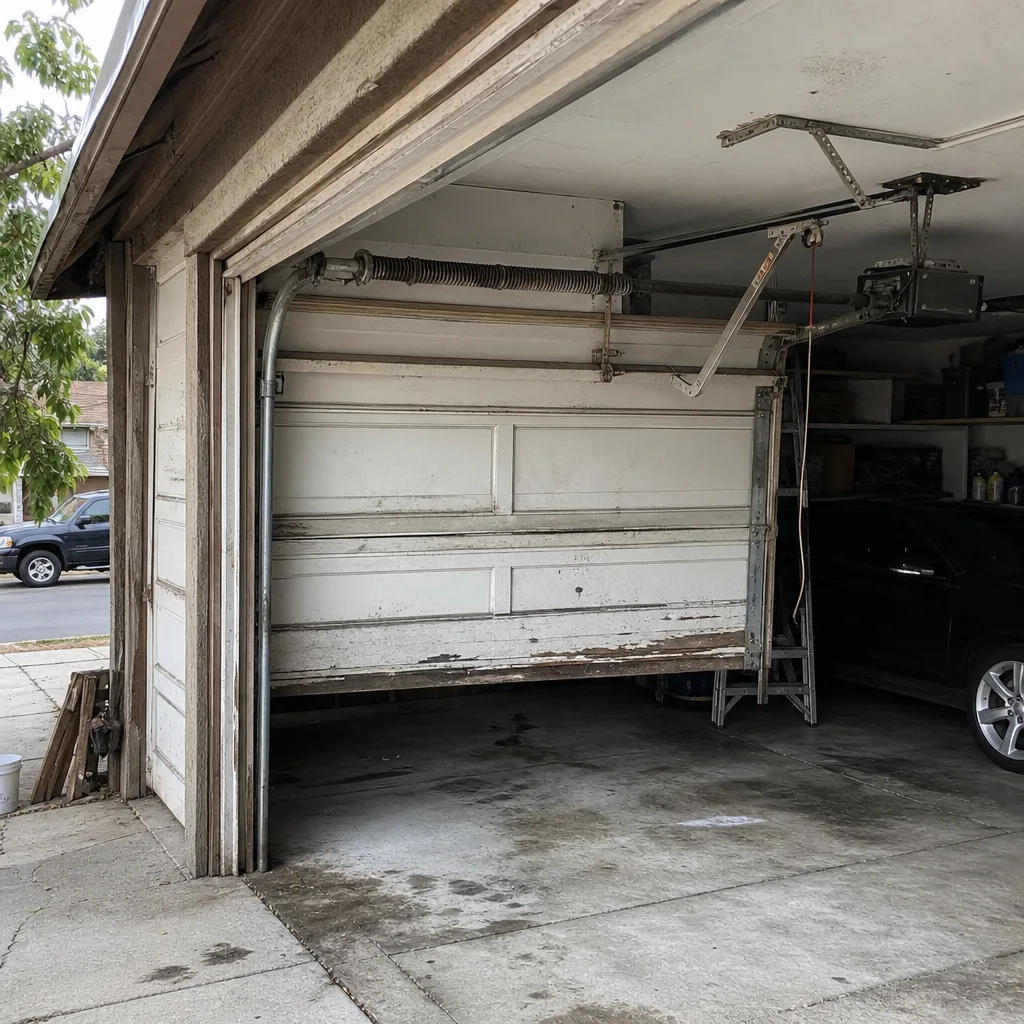 Before
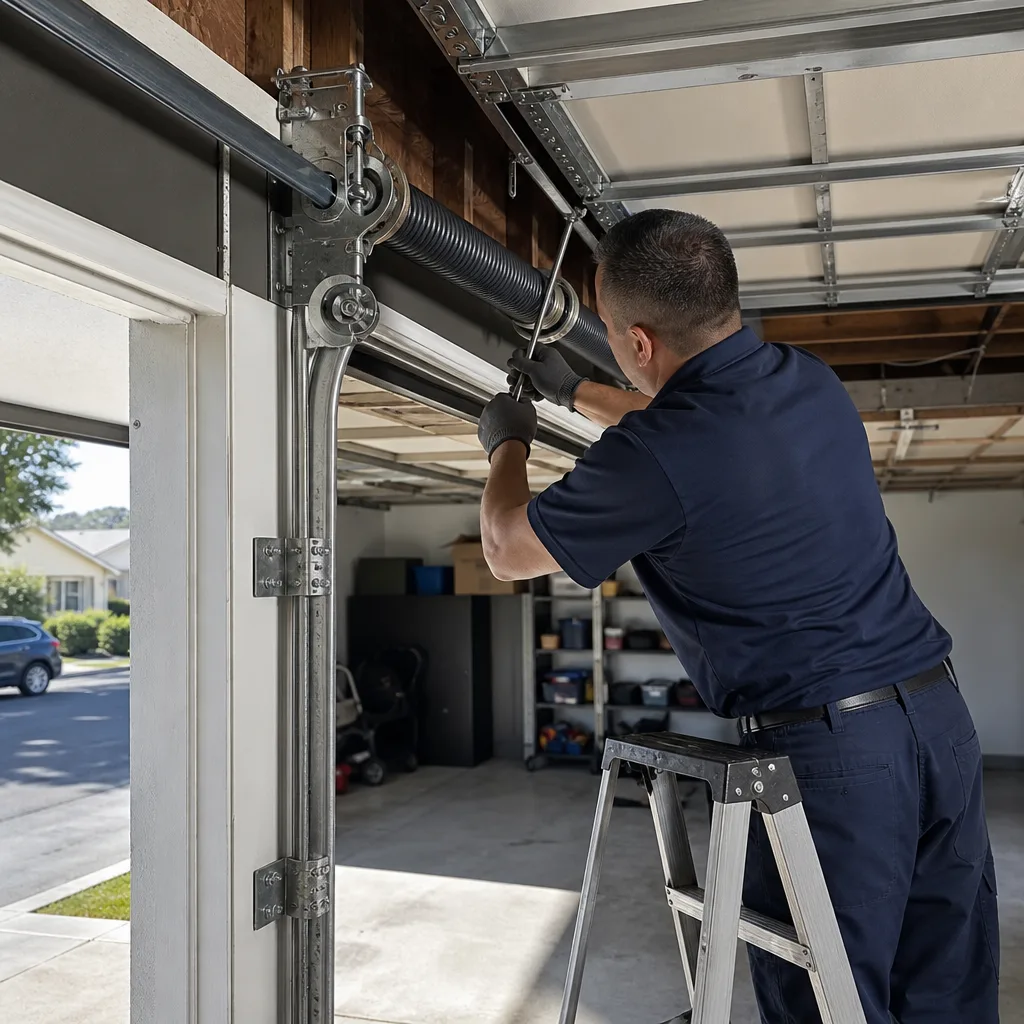 After
After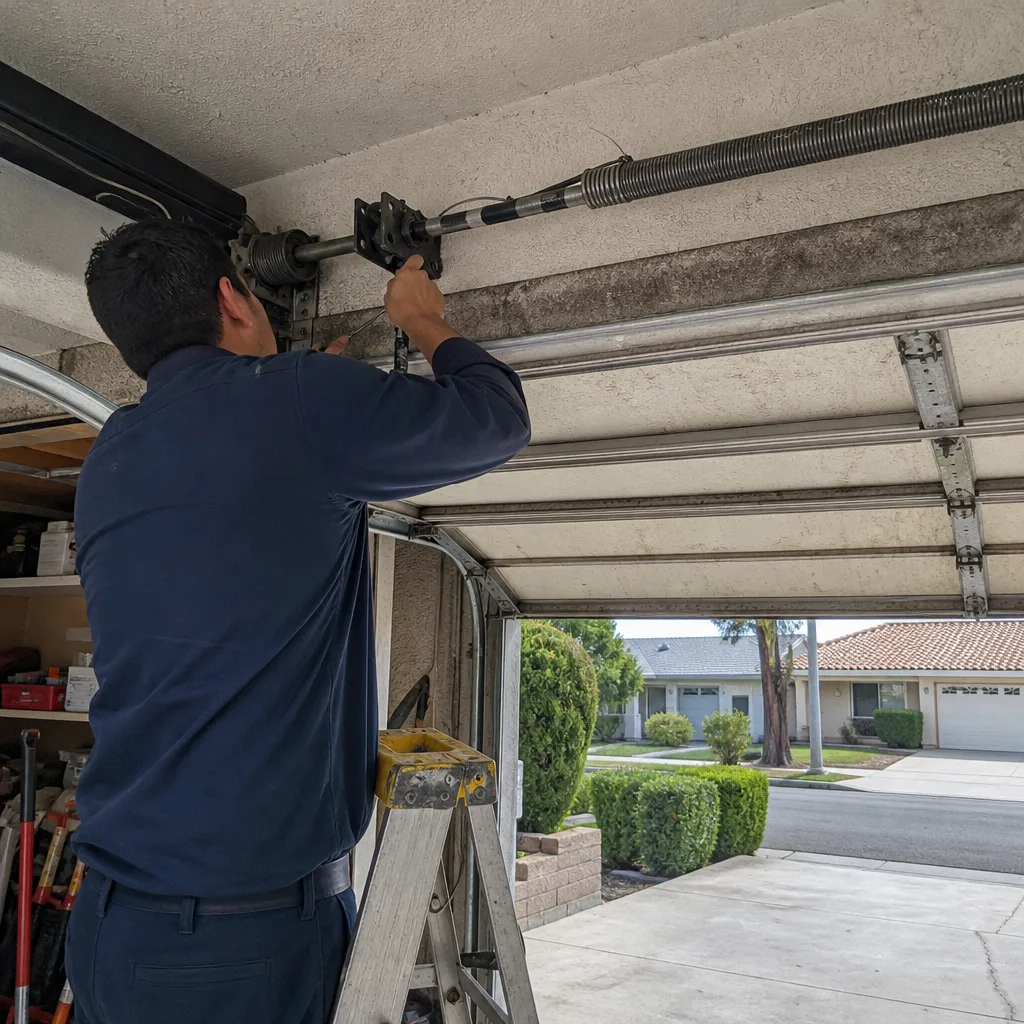 Before
 After
After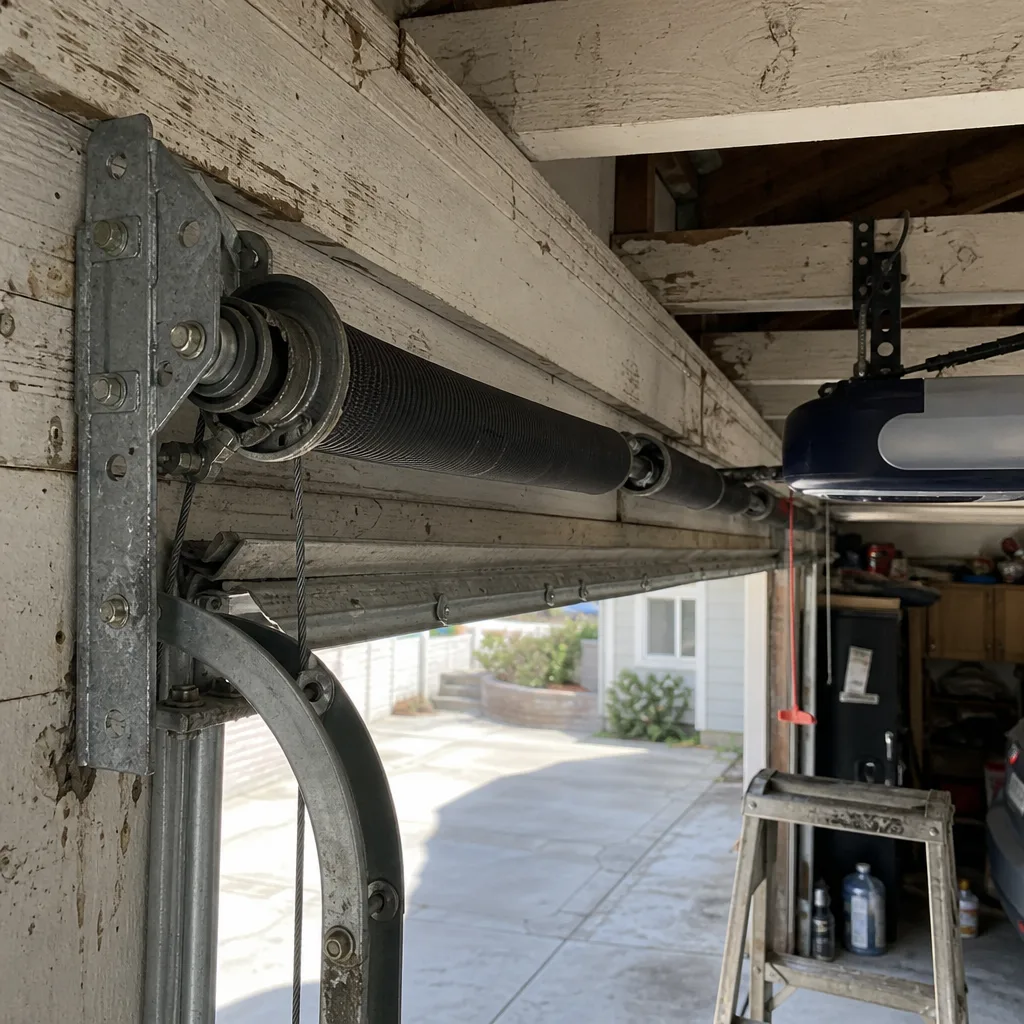 Before
 After
AfterWhen to Call a Professional
Spring replacement, cable replacement, and track repair are the three jobs that call for a trained technician. Torsion springs hold enormous tension and the cables that lift the door run alongside them, and a snapped cable can whip with enough force to break a hand. If your door is jerky, uneven, or making a sharp metallic noise, stop using it and call someone who does this work daily. Bramwell Garage Doors Los Angeles offers free estimates in Los Angeles, and our technicians arrive with a written price before any work starts. Call (213) 996-0290 to schedule a visit. For everything else, a monthly visual check and the maintenance schedule above will carry you a long way. We’ve been at this since 2001, and the lessons in this guide are the ones we’ve learned replacing doors from Malibu to Monterey Park, from Tujunga to San Pedro. The door is a machine like any other; treat it as one, and it will outlast whatever car sits beyond it.
Frequently Asked Questions
A quality steel garage door for a standard two-car opening in Los Angeles typically costs $800 to $2,400 installed, depending on insulation, windows, and hardware. Aluminum runs $1,200 to $2,400, and custom wood starts around $3,000. The single biggest cost driver beyond material is the spring system, which should be sized to the door’s exact weight. For an exact quote, call (213) 996-0290 and we’ll give you a written price before any work starts.
Standard 10,000-cycle torsion springs last roughly seven years under normal use, but in the San Fernando Valley’s summer heat, the same spring often fails at the five- to six-year mark. Upgrading to a 20,000-cycle spring costs about $20 to $40 more and roughly doubles the lifespan, making it the single wisest spring decision for a Valley address. Always ask what cycle rating you’re getting when you receive a spring quote.
Most spring replacements, cable repairs, and opener troubleshooting calls can be completed same-day, and our trucks carry the common parts for LiftMaster, Chamberlain, Genie, and Raynor systems. For emergencies like a door stuck open at night, call (213) 996-0290 and a live person will answer around the clock.
Yes. California law requires battery backup on all newly installed residential garage door openers since 2019. If your current opener predates that requirement, it won’t function during a power outage, which is a real issue during wildfire shutoffs and earthquake aftermath. Modern openers from LiftMaster and Chamberlain include battery backup as standard.
They are serviceable for now, but parts are getting scarce. The side hinges, pivot plates, and counterweight springs on one-piece doors are increasingly special-order, with lead times running two to three weeks. If you have a one-piece door in an older Los Angeles home, planning a conversion to a sectional door is cheaper in the long run than emergency repair after a failure.
Aluminum with stainless steel hardware is the right answer within five miles of the coast. It won’t corrode, and it’s light enough to reduce spring and opener load. Galvanized steel with stainless hardware is a solid second choice and slightly more dent-resistant. Raw steel panels will show rust on the lower section within three to five years in the marine layer, so avoid them entirely west of the 405.
The Bottom Line
Your Los Angeles garage door is a mechanical system built to survive a specific set of local conditions, and the decisions you make, material, spring rating, opener logic, track bracing, map directly to where in this city you live. A coastal home in Santa Monica needs different hardware than a Valley home in Reseda, and the difference shows up as years of service life. Choose materials for your geography, demand written pricing with cycle-rated springs, and maintain the door on a schedule that matches the LA rainy winter and hot summer. None of this is complicated, but it all compounds, and the homeowners who get it right are the ones who replace a spring once a decade instead of every six years. If you want a second set of eyes on your door, Bramwell Garage Doors Los Angeles is glad to help, free estimate, written price, and the 365-Day Done Right Promise in writing on every job.
Written by Marcus Ellery, Owner at Bramwell Garage Doors Los Angeles, serving Los Angeles since 2001.